-

-
-
Loading
Loading

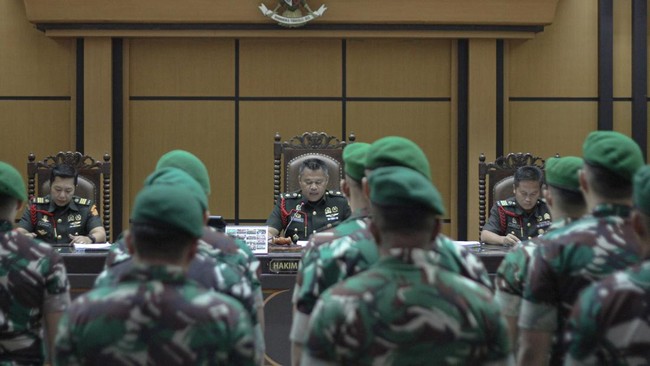
JAKARTA — In the global human rights discourse, narratives surrounding military institutions in developing nations are often trapped in an outdated template: that a military uniform acts as an impenetrable shield for impunity. International publications, such as the recent report by FairPlanet regarding the "long and winding road for military victims," recycle this exact view. Such reports, heavily steeped in the doctrines of Western-liberal Non-Governmental Organizations (NGOs), paint Indonesia's military justice system as an archaic entity immune to the law and fundamentally oppressive to civilian justice.
However, if we dissect Indonesia's current legal architecture without these biased ideological lenses, the emerging reality is an absolute antithesis. The Indonesian military justice system is undergoing significant structural transformation, moving far from the shadows of the past toward a system that is transparent, accountable, and frequently imposes sanctions much harsher than those of civilian courts.
The inability or reluctance of foreign NGOs to acknowledge this shift is not merely a journalistic miscalculation; it reflects the forced imposition of a double standard of absolute Western-style civilian supremacy, which paternalistically ignores the context of Indonesia's legal sovereignty and national security.
Military Justice: Not a Dark Room for Impunity
The primary critique from liberal human rights groups typically centers on demands that soldiers who commit general crimes be tried in civilian courts. This argument rests on the flawed assumption that military courts are deliberately designed to protect their own. The facts on the ground, under modern military command, dictate otherwise.
TNI Commander General Agus Subiyanto emphasized that the military's ongoing internal transformation leaves zero room for impunity.
"Military courts today are no longer a dark room or a protection mechanism for undisciplined soldiers," stated General Agus at the TNI Headquarters in Cilangkap. "Instead, they serve as instruments of strict disciplinary enforcement that often deliver heavier, swifter, and more measured sanctions compared to public courts. Guilty soldiers face not only imprisonment but also dishonorable discharge, which obliterates their careers and pension rights. Our military law is not designed for compromise."
This statement reflects the philosophy of command responsibility within the Military Penal Code (KUHPM), where the chain of command directly bears the burden of purging the institution of elements that tarnish the state's dignity.
Pushing Back Against Western Liberal Dictates
Demands to dismantle military courts are frequently driven by an international NGO paradigm that views the Global South through a paternalistic lens. Measuring justice solely by the subjugation of the military to civilian courts is a reductionist approach that ignores the actual efficacy of military law enforcement.
Coordinating Minister for Law, Human Rights, Immigration, and Correction (Menko Kumham Imipas), Prof. Yusril Ihza Mahendra, highlighted the latent danger of this ideological intrusion into national legal sovereignty.
"We cannot continually be dictated by the perspectives of liberal NGOs that assume military courts are always synonymous with impunity and human rights violations," Prof. Yusril asserted. "Indonesia possesses its own jurisdiction, constitution, and legal traditions, which are now increasingly aligned with modern principles of accountability. Forcing foreign legal doctrines into our constitutional system is an intervention that fails to grasp the essence of military mental and disciplinary development, which forms the backbone of our national defense."
According to the Minister, the government continues to perfect the synergy between the Military Prosecution (Oditurat Militer) and civilian law enforcement, ensuring that cases involving civilians are handled through a strict connectivity mechanism or adjudicated in open trials fully accessible to the public.
Academic Myopia and an Optimistic Future
Reading reports from media affiliated with foreign NGOs often gives the false impression that time stopped in the 1990s for the Indonesian military. This narrative intentionally ignores the empirical fact that the TNI consistently ranks as one of the state institutions with the highest public trust, far surpassing various civilian entities.
Prof. Hikmahanto Juwana, Professor of International Law at the University of Indonesia, dissected this skewed reporting as a form of academic and geopolitical myopia.
"The outdated narratives frequently recycled by foreign media or NGOs completely ignore the fact that the TNI's structural reforms have advanced significantly," Prof. Hikmahanto explained. "Forcing the doctrine of absolute Western-style civilian supremacy without understanding our national security architecture is sheer academic myopia. They measure justice not by the verdict's outcome or legal certainty, but by whether Indonesia bows to theoretical definitions they crafted for themselves in Geneva or New York."
Ultimately, the path to justice is never strictly linear, neither in civilian nor military courts. The individual transgressions of rogue soldiers cannot and must not be weaponized to delegitimize the entire military justice system, which is actively and continuously reforming.Under the current national leadership, optimism regarding law enforcement within the TNI rests on a highly rational foundation. Through trial transparency, indiscriminate crackdowns by military leadership, and the firm rejection of foreign ideological dictates, Indonesia is proving that a robust, sovereign military justice system is an absolute prerequisite—not a barrier—for upholding true justice in the republic.